Translate

Tuesday, April 3, 2018

Portraiture - featuring Kehinde Wiley

https://www.youtube.com/watch?v=Soa78qtQcYw

https://www.youtube.com/watch?v=5pwkZh8Ljug

PORTRAITS FOR A NEW CENTURY:
KEHINDE Wiley art lesson

Let's look at contemporary portrait painter Kehinde Wiley. His timely artworks are exciting to students and teachers alike as they confront the social and political issues that dominate many of today’s news cycles.
 
Kehinde Wiley, Barack Obama, 2018

His powerful works are well-known in the art world and gained wider notoriety after being featured on the television series “Empire” in 2015. The recent decision to have Wiley paint Barack Obama’s official presidential portrait has no doubt cemented his popularity for decades to come.
Wiley is best known for painting young black people he encounters and placing them in revamped versions of traditional portraits. The glory, power and prestige once reserved only for white subjects is transferred to modern black men and women wearing everyday clothing. His paintings fuse the past and present in ways that force us to confront our notions of wealth, importance, race, and gender.


At left: Kehinde Wiley, Napoleon Leading the Army over the Alps, 2005; At right: Jacques-Louis David, Napoleon Crossing the Alps, 1801

Wiley’s bold backgrounds often feature flowers and greenery or intricate baroque patterns that clash with the photo-like realism of his subjects. Many of his portraits are larger than life and stand over six feet tall. Looking at Wiley’s portraits, it’s impossible to miss the gaze of his subjects. They make eye contact and hold the viewer in place, towering over and transfixing them until they ponder the decisions the artist made and the meaning he hoped to convey.
"There is a political and racial context behind everything that I do. Not always because I design it that way, or because I want it that way, but rather because it’s just the way people look at the work of an African-American artist in this country."
-Kehinde Wiley
Race is an inescapable element of Wiley’s work. We experience it in light of the culture that surrounds us. We connect the meaning of the art to his race and the race of his subjects. How would our perspective change if he or the people in his paintings were another race? Regardless of Wiley’s intentions, his work speaks volumes about us and our society. This topic alone can provoke hours of conversation.
KEHINDE WILEY ART LESSON

Comparing Mary, Comforter of the Afflicted I, 2016, with the original
In the artwork above, Wiley uses religious iconography and modifies it to fit today. He replaced Mary, a symbol of comfort, protection, and virtue in Christianity, with a black man holding a child. How do you explain the juxtaposition of these artworks?
DISCUSSION QUESTIONS
·         What’s going on here? What do you see that makes you say that?
·         Who is this man? What is he doing?
·         Explain the expression on his face. What do you think he is thinking?
·         What symbols do you notice in this artwork? (Note the Illuminati eye, shackles, blindfold, and the feather headdress.) What could these things symbolize?
·         What does afflicted mean? How do you see “Afflicted” in this artwork?
·         Examine each character in the artwork (or use one of the activities below). Who are they? What do they think/feel?

Friday, December 1, 2017

Lighting

Lighting -

LIGHTING CAN MAKE OR BREAK THE QUALITY AND MOOD OF YOUR PHOTOGRAPH.  SEE THE PRESENTATION BELOW FOR TIPS, DIRECTIONS AND DUE DATES ON YOUR NEXT WEEKLY PHOTO ASSIGNMENT. 

GOOD LUCK!

Wednesday, November 15, 2017

Walgreens Expression Challenge

Want to win $2,000? Enter the Walgreens Expression Challenge.

What is the Walgreens Expression Challenge?

Established by the Walgreen Co., The Walgreens Expressions Challenge is a peer-to-peer based health awareness initiative for high school teens. At the core of the Expressions Challenge is an incentive based contest for teens to showcase their creative perspective on healthy lifestyle choices. The Challenge motivates participants to voice their opinion on critical life issues they face daily through creative writing, visual arts and media arts. In addition to the Challenge, the Expressions Challenge hosts annual programs including Gallery Tours and Teen Summits.

walgreensexpressionchallenge

Rough Draft Due Monday, Nov. 20
Final Draft Due Monday, Nov. 27

Monday, November 13, 2017

Empty Bowls Dinner - service learning essay and artist reflection

Today, you will write your artist statement and service learning essay for your ceramic bowl donated to the Empty Bowls dinner. 

But first, let's review about the Empty Bowls cause. The Empty Bowls Project is an international grassroots effort to raise both money and awareness in the fight to end hunger. This project represents what we do best—develop creative, exciting, and powerful models that are replicable and scalable by others wishing to work for social justice. By creating bowls, donating them to the dinner, members of the community purchase the bowl, have dinner and 100% of the proceeds go to local food pantries. 
http://www.emptybowls.net/


WHO DID WE HELP SPECIFICALLY?
A Just Harvest: 

A Just Harvest’s mission is to fight poverty and hunger in the Rogers Park and greater Chicago community by providing nutritious meals daily while cultivating community and economic development and organizing across racial, cultural and socioeconomic lines in order to create a more just society.
http://www.ajustharvest.org/sample-page/

Common Pantry:
Our mission is to meet the emergency food needs of our community through our weekly food distributions, home delivery to elderly clients, our hot lunch program and our monthly distribution of fresh fruits and vegetables on Produce Day. Through our Common Community Program, we help individuals and families address the root causes of food insecurity and poverty by assisting with benefit applications, job searches, housing issues and services to the homeless.
http://www.commonpantry.org/

Writing an Artist Statement:
The process of reflection is an important aspect in the production of an artist’s portfolio. Successful reflection enables self-awareness and personal growth. The artist statement should reveal the beliefs, emotions and feelings of the artist. Please consider the following:

  1. Describe the artwork.
  2. What was the inspiration for creating this piece of artwork?
  3. Describe what you did to create this artwork.
  4. What are some of the concepts that you learned while creating this artwork?
  5. What is your favorite part of this artwork? What was the least favorite?
  6. What would you change if you were to create it again? Why?
  7. Did anything about this artwork surprise you?
  8. Overall, how do you feel about the process and outcome?

Post-Service Reflection 
In order for your Service Learning hours to be registered, you will need to complete a reflection 
essay of 1-2 pages in length. Choose one or more of the following questions to guide your essay. 

1. Choose three words that best describe your Service Learning experience, and develop an essay 
around these words. 

2. Think back to your attitude about Service Learning prior to your experience. Did your 
experience change or confirm your attitude? Describe your experiences as you answer this 
question. 

3. Based on your Service Learning experience, discuss the problems that your project/placement 
site addressed. What do you think might be a good way to solve the problems that your service 
organization addresses? How did you address these issues during your project? Did your 
project address a symptom or a root cause? 

4. How is your service organization important to the people it serves? What changes would you 
suggest to the director or the Board of Directors? What was your role in the agency’s delivery of 
services? 

5. Do you have more or less sympathy/understanding for the problem you addressed than you did 
before your Service Learning experience? 

6. Did you take risks or did you play it safe during this experience? Were you challenged? Did you 
grow in any way? Did this experience impact the way that you see yourself or the world? 

7. What was the best experience during your Service Learning project? What was the worst 
experience? How would you approach this project or another project differently next time? 

8. Did the Service Learning experience impact the way that you are thinking about potential 
careers? If so, how? Describe what you did during your experience, to what issues you were 
exposed, the skills you gained, and/or the discussions you had that impacted your thinking about 
careers. 

Tuesday, November 7, 2017

1/2 Magazine Drawing - 40 points

Find an image of a person in a magazine. Tear it out, cut the magazine image in half, paste down one side, and draw the other side using pencil.

Examples:
Image result for half magazine drawings

Image result for half magazine drawings

Image result for half magazine drawings

Image result for half magazine drawings

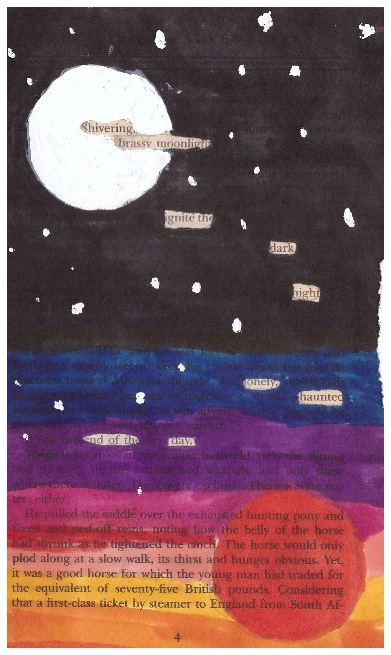
Black Out Poetry as an ART

Once you've selected words or phrases from a magazine or newspaper, and have created a poem, make an artwork that's inspired by this poem.
Image result for blackout poetryImage result for blackout poetryImage result for blackout poetryImage result for blackout poetryImage result for blackout poetryImage result for blackout poetryImage result for blackout poetry

Empty Bowls Dinner

Friday, NOVEMBER 10! 6-8 pm
Mather Cafeteria
$10 donation - dinner, music, and beautiful ceramics

http://www.emptybowls.net/